Sine and Arcsine in a Right Triangle
Sine and Arcsine. What are they and how to calculate them?
Definitions and calculations: sine and arcsine
Definitions
- Definition 1: The sine - In a right triangle the sine of an angle represents the ratio of the side opposite that angle to the hypotenuse.
- sin(∠A) = a/b
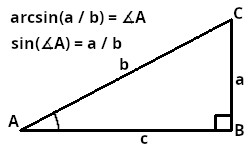
Sine and arcsine
- Definition 2: Arcsin (the arcsine) - This is the inverse of the standard sine mathematical function. While the sine function takes an angle and returns the corresponding ratio, the arcsin takes a ratio and returns the corresponding angle.
- Since sin and arcsin are inverse functions, arcsin(sin(∡A)) = ∡A. If we apply the function arcsin to the equality above:
- sin(∡A) = a/b => arcsin(sin(∡A)) = arcsin(a/b) <=>
- ∡A = arcsin(a/b) =>
- arcsin(a/b) = measure of angle ∡A
The sine of supplementary angles
- Definition: Two angles are supplementary if the sum of their measures equals 180 degrees (π radians).
- Example: An angle of 110° is supplementary to the one of 70°, because 110° + 70° = 180°.
- Supplementary angles sine formula:
sin(180° - θ) = sin(θ)
- How do we prove this formula?
- On the system of orthogonal axes xOy we have the circle with center O and radius r.
- We choose the point A on the circle so that the measure of the angle made by the segment OA with the axis Ox is equal to θ. C is the projection of point A on the axis Ox, i.e. AC is perpendicular to Ox. => In the right triangle △AOC, the measure of the angle ∡AOC is m(∡AOC) = θ.

The sine of supplementary angles
- We choose point B on the circle so that the measure of the angle made by the segment OB with the axis Ox is equal to (180° - θ). D is the projection of point B on the Ox axis, i.e. BD is perpendicular to Ox. => In the right triangle △BOD, the measure of the angle ∡BOD is m(∡BOD) = θ.
- Right triangles △AOC and △BOD are congruent (angle, θ, hypotenuse, r) => AC congruent to BD, AC ≅ BD.
- The sines of the angles ∡AOC and ∡BOC are:
But BD = AC (they have the same length, being congruent segments and are in similar quadrants in terms of Ox).
- => sin(∡BOC) = sin(180° - θ) = AC/r = sin(θ)
- => sin(180° - θ) = sin(θ)
Calculations examples
- Example 1: Calculating the sine
- In a right triangle that has the measure of the angle ∡B = 90°, the length of side b = 10 (the side opposite the angle ∡B) and the length of side a = 4 (the side opposite the angle ∡A), the sine of angle ∠A is calculated as:
-
Sine and arcsine
sin(∠A) = a/b = 4/10 = 2/5 = 0.4
- Example 2: Calculating the arcsine
- In a right triangle that has the measure of angle ∡B = 90°, the length of side b = 10 (the side opposite the angle ∡B) and the length of side a = 4 (the side opposite the angle ∡A), the measure of angle ∡A is calculated as:
- arcsin(sin(∠A)) = measure of angle ∡A = arcsin(a/b) = arcsin(4/10) = arcsin(2/5) = arcsin(0.4) = 23.578178478202° ≈ 23.58°.