Pythagoras' Theorem, Proof by Using a Square
Pythagoras' theorem in a right triangle. Formula and proof by using a square
Pythagoras' theorem. Formula. Demonstration. Calculation examples
Pythagoras' Theorem
- In any right triangle, the sum of the squares of the legs is equal to the square of the hypotenuse:
- c2 = a2 + b2
- Where:
- a and b are the lengths of the two legs
- c is the length of the hypotenuse
Generalized Pythagoras' Theorem
- The generalized Pythagorean Theorem, also called the Cosine Theorem, establishes a relationship between the length of one side of a given triangle and the other two sides, using the cosine of the angle between those two sides, as follows:
c2 = a2 + b2 - 2 × a × c × cos(∠C)
However, if the measure of the angle ∠C is m(∡C) = 90° => cos(90°) = 0, the formula of the generalized Pythagorean Theorem becomes the classical Pythagorean Theorem:
c2 = a2 + b2
Proof of the Pythagorean Theorem
1. We build a square with the side length L = a + b
- We place inside this square four congruent right triangles. The lengths of the legs of these right squares are a and b respectively, as in the adjacent figure.
- The length of the four hypotenuses is equal to c.
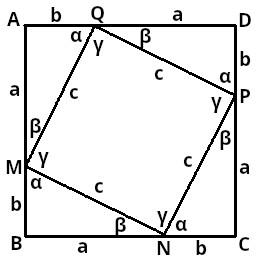
Demonstration of the Pythagorean Theorem using the square
- The four triangles are congruent and the measures of the angles α + β = 90°.
- It turns out that the measures of the angles γ = 180° - (α + β) = 180° - 90° = 90°.
- So it turns out that the polygon of side c is a square.
2. We calculate the area of the large square by two methods
- The area of the large square, AreaL, can be obtained the simplest by multiplying its sides:
AreaL = L × L = L2 = (a + b)2
However, the area of the large square, AreaL, can also be obtained by adding the areas of the geometric shapes that make it up, i.e. the four congruent right triangles and the smaller square, of side c, formed in the center:
AreaL = 4 × 1/2 × a × b + c × c = 2 × a × b + c2
3. We put the two relations in equality:
- Both equations represent the area of the large square, AreaL, calculated in different ways, so they are equal to each other.
2 × a × b + c2 = (a + b)2
Undo the bracket:
2 × a × b + c2 = a2 + 2 × a × b + b2
We cross off the common term, "2 × a × b", on both sides of equality, and obtain the Pythagorean Theorem:
c2 = a2 + b2
Why is the Pythagorean Theorem important
- The Pythagorean theorem establishes a relationship between the lengths of the sides of a right triangle.
- Applying the Pythagorean theorem we can determine whether a triangle is right-angled or not.
- Pythagoras' theorem has many practical applications: in geometry it is the basis of trigonometry, it is used to calculate the distances between two points on a map, it is the basis of localization systems on digital maps or to establish routes, it is used in construction and architecture to construct 90 degree angles, and in physics and engineering to decompose forces or velocities.
Calculation examples using the Pythagorean theorem
Example 1: calculation of the hypotenuse in a right triangle
- We have a right triangle with legs of lengths a = 3 and b = 4, let's calculate the length of the hypotenuse, c.
- c2 =
- a2 + b2 =
- 32 + 42 =
- 9 + 16 =
- 25 =
- 52 =>
- c = 5
Example 2: we check if a triangle is right-angled
- We have a triangle with side lengths a = 4, b = 7 and c = 8, let's check if it is a right triangle.
- We assume that the triangle is right-angled, we apply the Pythagorean Theorem and see if it is verified.
- c2 = 82 = 64
- a2 + b2 = 42 + 72 = 16 + 49 = 65
- c2 ≠ a2 + b2
The theorem of Pythagoras is not verified, so the triangle is not right-angled.