The Heron's Formula, a Proof Using the Pythagorean Theorem
The Heron's formula. A step-by-step proof using the Pythagorean theorem
The Heron's Formula. Proof
Heron's Formula
- Given the lengths of its three sides, the area of a triangle can be calculated using the Heron's Formula:
- Area2 = s × (s - a) × (s - b) × (s - c)
- Where:
- a, b and c are the lengths of the three sides of the triangle
- s is the semiperimeter of the triangle s = P/2
- P is the perimeter of the triangle, P = a + b + c
- s = (a + b + c)/2
Step-by-Step Pythagorean Proof of Heron's Formula
- Consider a triangle △ABC with its sides BC = a, AC = b and AB = c. Draw the height from vertex A, opposite to side "a", AD ⊥ BC, D ∈ BC, AD = h. AD splits the base "a" into two segments, BD = x and CD = a - x.
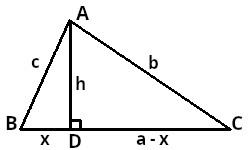
Triangle △ABC for Heron's Formula
Apply the Pythagorean Theorem to the right-angled triangle △ADB:
- h2 + x2 = c2
- h2 = c2 - x2
Apply the Pythagorean Theorem to the right-angled triangle △ADC:
- h2 + (a - x)2 = b2
- h2 = b2 - (a - x)2
Equate the two expressions for h2 and solve for the segment "x":
- c2 - x2 = b2 - (a - x)2
- c2 - x2 = b2 - (a2 - 2 × a × x + x2)
- c2 - x2 = b2 - a2 + 2 × a × x - x2
- c2 = b2 - a2 + 2 × a × x
- 2 × a × x = a2 + c2 - b2
- x = (a2 + c2 - b2)/(2 × a)
Substitute "x" back into the formula of h2 and calculate the height "h":
- h2 = c2 - x2
- h2 = c2 - ((a2 + c2 - b2)/(2 × a))2
- h2 = c2 - (a2 + c2 - b2)2/(2 × a)2
Convert the two "fractions" to a common denominator
- h2 = c2 × (2 × a)2/(2 × a)2 - (a2 + c2 - b2)2/(2 × a))2
- h2 = (c2 × (2 × a)2)/(2 × a)2 - (a2 + c2 - b2)2/(2 × a))2
- h2 = (c2 × (2 × a)2 - (a2 + c2 - b2)2) / (2 × a))2
- h2 = ((2 × a × c)2 - (a2 + c2 - b2)2) / (2 × a))2
Factor the expression using the difference of squares rule, c2 - x2 = (c - x) × (c + x)
- h2 = (2 × a × c - a2 - c2 + b2) × (2 × a × c + a2 + c2 - b2) / (2 × a)2
Apply the abbreviated calculation formulas:
(a2 - 2 × a × c + c2) = (a - c)2
(a2 + 2 × a × c + c2) = (a + c)2
- h2 = (b2 - (a2 - 2 × a × c + c2)) × ((a2 + 2 × a × c + c2) - b2) / (2 × a)2
- h2 = (b2 - (a - c)2) × ((a + c)2 - b2) / (2 × a)2
- h2 = (b - a + c) × (b + a - c) × (a + c - b) × (a + c + b) / (2 × a)2
- h2 = (a + b + c) × (b + c - a) × (a + c - b) × (a + b - c) / (2 × a)2
Substitute for h2 into the Area's Formula:
- Area = 1/2 × a × h
- Area2 = 1/4 × a2 × h2
- Area2 = 1/4 × a2 × (a + b + c) × (b + c - a) × (a + c - b) × (a + b - c) / (4 × a2)
- Area2 = 1/16 × (a + b + c) × (b + c - a) × (a + c - b) × (a + b - c)
Use the semi-perimeter s = (a + b + c)/2 to express the factors of the last formula of the area from above:
- s = (a + b + c)/2
- a + b + c = 2 × s
- b + c - a = 2 × s - 2 × a = 2 × (s - a)
- a + c - b = 2 × s - 2 × b = 2 × (s - b)
- a + b - c = 2 × s - 2 × c = 2 × (s - c)
Rewrite the last formula of the area using the Heron's Formula:
- Area2 = 1/24 × 2 × s × 2 × (s - a) × 2 × (s - b) × 2 × (s - c)
- Area2 = s × (s - a) × (s - b) × (s - c) - Heron's Formula
Example: let's calculate the area of a triangle using the Heron's Formula
- Let's calculate the area of a triangle with the sides' lengths a = 12, b = 17 and c = 14 units.
Area2 =
- s × (s - a) × (s - b) × (s - c) =
- 21.5 × (21.5 - 12) × (21.5 - 17) × (21.5 - 14) =
- 21.5 × 9.5 × 4.5 × 7.5 =
- 6,893.4375 ≈
- 6,893.44