The Apollonius' Theorem. Formula and Proof
Apollonius' Theorem and the Medians in a Triangle. Formula. Proof
The medians and the Apollonius' theorem. Proof. Calculation example
The medians in a triangle
- Definition: A median of a triangle is a line segment connecting a vertex of the triangle to the midpoint of the opposite side.
- Every triangle has three medians that meet at a single center point, called centroid.
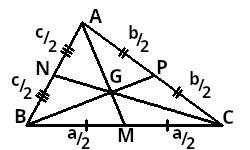
The three medians of the triangle
- In the triangle △ABC ma is the median connecting the vertex A to the middle of side BC, mb is the median connecting the vertex B to the middle of side AC and mc is the median connecting the vertex C to the middle of the side AB. All the medians intersect at point G, the centroid.
- The point G divides the lengths of the three medians as follows:
- AG/AM = BG/BP = CG/CN = 2/3
- GM/AM = GP/BP = GN/CN = 1/3
- GM/AG = GP/BG = GN/CG = 1/2
Apollonius' Theorem
- In a triangle △ABC, for which we know the lengths of the sides "a", "b" and "c", having the opposite vertices A, B and C, respectively, there is a relationship between the lengths of the sides and the lengths of the medians ma, mb and mc, where ma is drawn from vertex A to side "a", mb is drawn from vertex B to side "b", and mc is drawn from vertex C to side "c":
- b2 + c2 = 2 × (ma2 + (a/2)2) =>
- ma2 = (b2 + c2)/2 - (a/2)2
- a2 + c2 = 2 × (mb2 + (b/2)2) =>
- mb2 = (a2 + c2)/2 - (b/2)2
- a2 + b2 = 2 × (mc2 + (c/2)2) =>
- mc2 = (a2 + b2)/2 - (c/2)2
Proof of the Apollonius' Theorem
- We prove Apollonius' Theorem using the Law of Cosines, also called the Generalized Pythagorean Theorem, which is also used to calculate the angles' measures in a triangle.
- » Law of Cosines or the Generalized Pythagorean Theorem. Formula and Proof
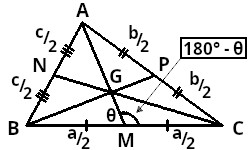
The three medians of the triangle Proof of the Apollonius' Theorem
- Let median AM, of lenght ma, divide the side BC, of length "a", into two equal parts, of length BM = CM = a/2. Also the legths of AB = c, AC = b, BC = a.
- Let the measure of the angle ∡AMB = θ. Since two angles on a straight line add up to 180° then the adjacent angle ∡AMC = 180° - θ.
- => cos(180° - θ) = - cos(θ)
- » Cosine and Arccosine in a Right Triangle
Apply the Law of Cosines to the triangle △ABM, making sure to also include the angle ∡AMB = θ in the formula:
- c2 = ma2 + (a/2)2 - 2 × ma × a/2 × cos(θ)
- => [1] c2 = ma2 + (a/2)2 - ma × a × cos(θ)
Apply the Law of Cosines to the triangle △ACM, making sure to also include the angle ∡AMC = 180° - θ in the formula:
- b2 = ma2 + (a/2)2 - 2 × ma × a/2 × cos(180° - θ)
- Substitute for the expression: cos(180° - θ) = - cos(θ)
- The initial above relation becomes:
- [2] b2 = ma2 + (a/2)2 + ma × a × cos(θ)
- Add the two equations [1] and [2] together. The terms "ma × a × cos(θ)" and "- ma × a × cos(θ)" cancel each other:
b2 + c2 = 2 × (ma2 + (a/2)2) - Apollonius' Theorem
Calculation example
- Let's calculate the medians ma, mb and mc of a triangle if all the sides' lengths are given: a = 12, b = 10 and c = 8.
- Apply the Apollonius' Theorem and solve for the medians:
- b2 + c2 = 2 × (ma2 + (a/2)2) =>
- ma2 =
- (b2 + c2)/2 - (a/2)2 =
- (102 + 82)/2 - (12/2)2 =
- (100 + 64)/2 - 62 =
- 164/2 - 36 =
- 82 - 36 =
- 46
- => The median ma ≈ 6.782329983125 ≈ 6.78
- a2 + c2 = 2 × (mb2 + (b/2)2) =>
- mb2 =
- (a2 + c2)/2 - (b/2)2 =
- (122 + 82)/2 - (10/2)2 =
- (144 + 64)/2 - 52 =
- 208/2 - 25 =
- 104 - 25 =
- 79
- => The median mb ≈ 8.888194417316 ≈ 8
- a2 + b2 = 2 × (mc2 + (c/2)2) =>
- mc2 =
- (a2 + b2)/2 - (c/2)2 =
- (122 + 102)/2 - (8/2)2 =
- (144 + 100)/2 - 42 =
- 244/2 - 16 =
- 122 - 16 =
- 106
- => The median mc = 10 ≈ 10