How To Calculate the Area of a Triangle, Given the Lengths of Two Sides and the Measure of the Angle Between Them? Trigonometric Formula
Learn to calculate the area of a triangle given the lengths of two sides and the measure of the angle between. Trigonometric formula of area
Method to calculate the area of triangle. Trigonometric formula
Side's length - Angle's measure - Side's length
- This method of calculating the area of a triangle involves knowing the lengths of two sides and the measure of the angle between them.
- In a triangle △ABC with side lengths BC = a, AC = b, and AB = c, the lengths of a and b are known, as well as the measure of angle ∠C.
We start with the classic formula of triangle's area:
- Area = 1/2 × a × ha
- Where:
- a = the side of the triangle opposite angle ∠A
- ha = the height AD from the vertex A to the side with length "a" (BC), where D belongs to the line containing the segment BC.
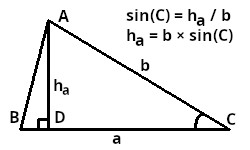
Height ha as a function of the side b and the sine of angle ∠C
- == But we don't know the length of the height ha. What next? ==
- Using notions of trigonometry, in the right triangle △ADC (∡D = 90°), formed to the right of the height ha, we have:
- sin(∠C) = ha / b => ha = b × sin(∠C).
- Substitute the height ha into the classic formula of the triangle's area and get:
The trigonometric formula:
- Area = 1/2 × a × b × sin(∠C)
Practical example: calculate the area of a triangle
Let's calculate the area of a triangle with the side lengths a = 10, b = 9, and the angle measure of m(∠C) = 40 degrees.
Area =
- 1/2 × a × b × sin(∠C) =
- 1/2 × 10 × 9 × sin(40 degrees) =
- 1/2 × 10 × 9 × sin(0.698131701 radians) ≈
- 45 × 0.64278760984 =
- 28.9254424429 ≈
- 28.93 square units