Solve the Triangle Given Its Three Sides' Lengths: 73, 78 and 80. Triangle Calculator: Angles, Area, (Semi)Perimeter, Heights, Medians, Circles Radii

Calculate the angles and the area of ​​the triangle, the (semi)perimeter, the three heights and medians and the radii of the inscribed and circumscribed circles of the triangle


  • The given triangle is solved below step by step, with full explanations of the used formulas, clear explanations on the used terms and with illustrative pictures.
  • At the end, all the calculated data of the triangle is summarized in one section.
  • The order of steps of solving the triangle: 1) calculating the perimeter, 2) the semiperimeter, 3) the measures of the angles, 4) the area - calculated by two methods, 5) the lengths of the three heights of the triangle, 6) the lengths of the three medians of the triangle, 7) the radius of the inscribed circle of the triangle and 8) the radius of the circumscribed circle.

Scalene triangle

  • This is a scalene triangle, with all the lengths of its sides different from each other, without being a right triangle.
  • The triangle is not equilateral, nor isosceles, nor right-angled, things that can be determined easily from the lengths of the sides.

2. Calculate the semiperimeter, s = (a + b + c) / 2

Divide the perimeter by 2.

  • s =
  • (73 + 78 + 80) / 2 =
  • 231 / 2 =
  • 115.5

3. Calculate the angles' measures of the triangle

  • Definitions

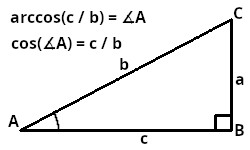
  • Definition 1: Cosine - In a right triangle the cosine of an angle represents the ratio of the side adjacent to the angle to the hypotenuse.
  • cos(∠A) = c/b
  • Cosine and arccosine

    Cosine and arccosine

  • Definition 2: Arccos (the arccosine) - This is the inverse of the standard cosine mathematical function. While the cosine function takes an angle and returns the corresponding ratio, the arccos takes a ratio and returns the corresponding angle.
  • Since cos and arccos are inverse functions, arccos(cos(∡A)) = ∡A; if we apply the function arccos to the equality above:
  • cos(∡A) = c/b => arccos(cos(∡A)) = arccos(c/b) <=>
  • ∡A = arccos(c/b) =>
  • arccos(c/b) = measure of angle ∡A
  • Calculations examples

  • Example 1: Calculating the cosine
  • In a right triangle that has the measure of the angle ∡B = 90°, the length of side b = 10 and the length of side c = 6, the cosine of angle ∠A is calculated as:
  • cos(∠A) = c/b = 6/10 = 3/5 = 0.6.
  • Example 2: Calculating the arccosine
  • In a right triangle that has the measure of angle ∡B = 90°, the length of side b = 10 and the length of side c = 6, the measure of angle ∡A is calculated as:
  • arccos(cos(∠A)) = measure of angle ∡A = arccos(c/b) = arccos(6/10) = arccos(3/5) = arccos(0.6) = 53.1301024° ≈ 53.13°.

To calculate the angles measures, use the three formulas below.

These formulas are directly derived from, and a rearrangement for angles, of the Law of Cosine (or generalized Pythagorean Theorem).


  • m(∡A) = arccos((b2 + c2 - a2) / (2 × b × c))
  • m(∡B) = arccos((a2 + c2 - b2) / (2 × a × c))
  • m(∡C) = arccos((a2 + b2 - c2) / (2 × a × b))
  • Where:
  • a = the side of the triangle opposite angle ∠A
  • b = the side of the triangle opposite angle ∠B
  • c = the side of the triangle opposite angle ∠C

  • Why this formula? Proof of the Law of Cosine

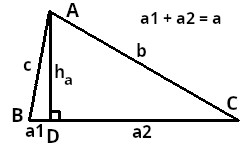
  • In any triangle △ABC, which is not right-angled, with side lengths BC = a, AC = b and AB = c, we draw from the vertex A the perpendicular to the side BC, which intersects BC in point D. We note the lengths of the sides AD = ha, BD = a1 and CD = a2, where a1 + a2 = a.
  • Proof of the Law of Cosine

    Proof of the Law of Cosine

  • In the right triangle △ABD we have the following trigonometric relations:
  • sin(∠B) = ha/c => ha = c × sin(∠B)
  • cos(∠B) = a1/c => a1 = c × cos(∠B)
  • In the right triangle △ADC we apply the Pythagorean Theorem:
  • b2 = ha2 + a22 <=>
  • b2 = ha2 + (a - a1)2

  • Substitute for ha and a1 in the formula above:
  • b2 = c2 × sin2(∠B) + (a - c × cos(∠B))2 <=>
  • b2 = c2 × sin2(∠B) + a2 - 2 × a × c × cos(∠B) + c2 × cos2(∠B) <=>
  • b2 = c2 × (sin2(∠B) + cos2(∠B)) + a2 - 2 × a × c × cos(∠B) <=>
  • b2 = c2 × (ha2/c2 + a12/c2) + a2 - 2 × a × c × cos(∠B) <=>
  • b2 = c2 × (ha2 + a12)/c2 + a2 - 2 × a × c × cos(∠B) <=>

  • In the right triangle △ABD ha2 + a12 = c2 (Pythagora's Theorem) =>
  • (ha2 + a12)/c2 = 1 =>

  • b2 = c2 + a2 - 2 × a × c × cos(∠B) <=>
  • cos(∠B) = (a2 + c2 - b2) / (2 × a × c)
  • Apply function arccos to both sides of the equality:
  • arccos(cos(∠B)) = arccos((a2 + c2 - b2) / (2 × a × c)) =>
  • m(∡B) = arccos((a2 + c2 - b2) / (2 × a × c))
  • The same process is used to calculate the measures of angles ∠A and ∠C.

  • Last three definitions: π. Radians. Degrees

  • Definition: π represents the constant ratio of a circle's circumference (circle's length), C, to its diameter, d (d = 2 × r, where r is the radius of the circle), which is approximately 3.14159, commonly estimated as the fraction 22/7.
    π = C/d = C/(2 × r)
  • Angle measurement: π. Radians. Degrees

    Angle measurement: π. Radians. Degrees

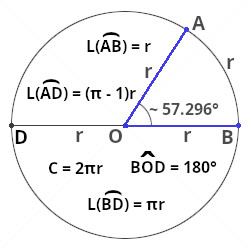
  • Definition: A radian is a standard unit of angle measurement. A radian is equal to the angle formed when the length of the arc of a circle is equal to the radius of the same circle. There are exactly 2π radians in the circumference (the length) of a circle (any circle). 1 radian is roughly 57.296° (degrees). An angle of 360° = 2π radians, 180° = π radians, 90° = π/2 radians, 45° = π/4 radians.
  • Definition: Angles are usually measured in degrees (°). A degree is a standard unit of angle measurement. The angle formed by a complete circle is 360°. An obtuse angle is between (90° and 180°). A right angle is 90°. An acute angle is between (0° and 90°).

Calculate the measure of angle ∠A

  • m(∡A) =
  • arccos((782 + 802 - 732) / (2 × 78 × 80)) =
  • arccos((6,084 + (80 + 73) × (80 - 73))) / 12,480) =
  • arccos((6,084 + 153 × 7)) / 12,480) =
  • arccos((6,084 + 1,071)) / 12,480) =
  • arccos(7,155/12,480) =
  • arccos(0.573317307692) =
  • 0.96024739125738 radians =
  • (0.96024739125738 radians × 360 degrees) / (2 × π radians) =
  • (0.96024739125738 × 180 degrees) / π =
  • 55.018122807495 degrees =
  • 55 degrees, 1 minutes and 5.24 seconds

Calculate the measure of angle ∠B

  • m(∡B) =
  • arccos((732 + 802 - 782) / (2 × 73 × 80)) =
  • arccos((5,329 + (80 + 78) × (80 - 78))) / 11,680) =
  • arccos((5,329 + 158 × 2)) / 11,680) =
  • arccos((5,329 + 316)) / 11,680) =
  • arccos(5,645/11,680) =
  • arccos(0.483304794521) =
  • 1.0663705735026 radians =
  • (1.0663705735026 radians × 360 degrees) / (2 × π radians) =
  • (1.0663705735026 × 180 degrees) / π =
  • 61.098533258644 degrees =
  • 61 degrees, 5 minutes and 54.72 seconds

Calculate the measure of angle ∠C

  • m(∡C) =
  • arccos((732 + 782 - 802) / (2 × 73 × 78)) =
  • arccos((5,329 + (78 + 80) × (78 - 80))) / 11,388) =
  • arccos((5,329 + 158 × - 2)) / 11,388) =
  • arccos((5,329 + - 316)) / 11,388) =
  • arccos(5,013/11,388) =
  • arccos(0.440200210748) =
  • 1.1149746888299 radians =
  • (1.1149746888299 radians × 360 degrees) / (2 × π radians) =
  • (1.1149746888299 × 180 degrees) / π =
  • 63.883343933865 degrees =
  • 63 degrees, 53 minutes and 0.04 seconds

Check that the sum of the angles ∡A + ∡B + ∡C = 180°

  • ∡A = 55.018122807495°
  • ∡B = 61.098533258644°
  • ∡C = 63.883343933865°

Note: The sum of the angles is approximately 180° instead of exactly 180°. This is because we performed calculations that required rounding: calculating the arccos and converting from radians to degrees.


  • m(∡A) + m(∡B) + m(∡C) =
  • 55.018122807495° + 61.098533258644° + 63.883343933865° =
  • 180.000000000004° ≈ 180°

4.1. Calculate the area of the triangle

Method 1. Longer

  • This method requires more steps to get to the result than the second one.
  • In theory, both calculation formulas will arrive at exactly the same result. But in practice, when using calculation tools that involve rounding and approximations, it is better to use the calculation method that involves fewer steps, and fewer approximations.
  • This method is presented here for demonstrative purposes, we will calculate the area using the second method, which involves fewer steps and fewer approximations.

  • The classic formula:

  • Area = 1/2 × a × ha
  • Where:
  • a = the side of the triangle opposite angle ∠A
  • ha = the height AD from the vertex A to the side "a" (BC), where D belongs to the line containing the segment BC.
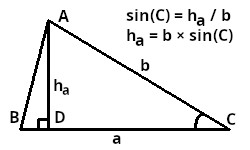
  • Height ha expressed as a function of the side

    Height ha expressed as a function of the side "b" and the sine of angle C

  • == But we don't know the height ha. What to do next? ==
  • Using trigonometry, in the right triangle △ADC (∡D = 90°), formed to the right of the height ha:
  • sin(∠C) = ha / b
  • It follows that ha = b × sin(∠C).
  • Substitute the height ha into the classic formula of the area and get:
  • Trigonometric formula:

  • Area = 1/2 × a × b × sin(∠C)

Calculate the area of the triangle

  • Area =

  • 1/2 × a × b × sin(∠C) =
  • 1/2 × 73 × 78 × sin(63.883343933865 degrees) =
  • 1/2 × 73 × 78 × sin(1.1149746888299 radians) ≈
  • 2,847 × 0.897899646095 =
  • 2,556.320292432465 ≈
  • 2,556.32 square units

Note: Area will be calculated using the 2nd method, which involves fewer steps and approximations.


4.2. Calculate the area of the triangle

Method 2. Shorter

  • Heron's Formula

  • Given the lengths of its three sides, the area of a triangle can be calculated using the Heron's Formula:
  • Area2 = s × (s - a) × (s - b) × (s - c)
  • Where:
  • a, b and c are the lengths of the three sides of the triangle
  • s is the semiperimeter of the triangle, already calculated above
  • Step-by-Step Pythagorean Proof of Heron's Formula

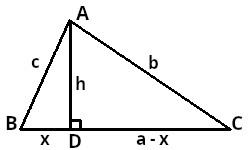
  • Consider a triangle △ABC with its sides BC = a, AC = b and AB = c. Draw the height from vertex A, opposite to side "a", AD ⊥ BC, D ∈ BC, AD = h. AD splits the base "a" into two segments, BD = x and CD = a - x.
  • Triangle △ABC for Heron's Formula

    Triangle △ABC for Heron's Formula

  • Apply the Pythagorean Theorem to the right-angled triangle △ADB:
  • h2 + x2 = c2 =>
  • h2 = c2 - x2
  • Apply the Pythagorean Theorem to the right-angled triangle △ADC:
  • h2 + (a - x)2 = b2 =>
  • h2 = b2 - (a - x)2
  • Equate the two expressions for h2 and solve for the segment "x":
  • c2 - x2 = b2 - (a - x)2 <=>
  • c2 - x2 = b2 - (a2 - 2 × a × x + x2) <=>
  • c2 - x2 = b2 - a2 + 2 × a × x - x2 <=>
  • c2 = b2 - a2 + 2 × a × x <=>
  • 2 × a × x = a2 + c2 - b2 <=>
  • x = (a2 + c2 - b2)/(2 × a)
  • Substitute "x" back into the formula of h2 and calculate the height "h":
  • h2 = c2 - x2 <=>
  • h2 = c2 - ((a2 + c2 - b2)/(2 × a))2
  • Factor the expression using the difference of squares rule, c2 - x2 = (c - x) × (c + x):
  • h2 = ((2 × a × c)2 - (a2 + c2 - b2)2) / (2 × a))2 <=>
  • h2 = (2 × a × c - a2 - c2 + b2) × (2 × a × c + a2 + c2 - b2) / (2 × a)2 <=>
  • h2 = (b2 - (a2 - 2 × a × c + c2)) × ((a2 + 2 × a × c + c2) - b2) / (2 × a)2 <=>
  • h2 = (b2 - (a - c)2) × ((a + c)2 - b2) / (2 × a)2 <=>
  • h2 = (b - a + c) × (b + a - c) × (a + c - b) × (a + c + b) / (2 × a)2 <=>
  • h2 = (a + b + c) × (b + c - a) × (a + c - b) × (a + b - c) / (2 × a)2
  • Substitute for h2 into the Area Formula:
  • Area = 1/2 × a × h => Area2 = 1/4 × a2 × h2 =>
  • Area2 = 1/4 × a2 × (a + b + c) × (b + c - a) × (a + c - b) × (a + b - c) / (4 × a2) <=>
  • [1] Area2 = 1/16 × (a + b + c) × (b + c - a) × (a + c - b) × (a + b - c)
  • Use the semi-perimeter s = (a + b + c)/2 to express the factors of the formula [1] above:
  • => a + b + c = 2 × s
  • => b + c - a = 2 × s - 2 × a = 2 × (s - a)
  • => a + c - b = 2 × s - 2 × b = 2 × (s - b)
  • => a + b - c = 2 × s - 2 × c = 2 × (s - c)
  • Rewrite formula [1]:
  • Area2 = 1/24 × 2 × s × 2 × (s - a) × 2 × (s - b) × 2 × (s - c) <=>
  • Area2 = s × (s - a) × (s - b) × (s - c) - Heron's Formula

Calculate the area of the triangle

  • Area2 =

  • s × (s - a) × (s - b) × (s - c) =
  • 115.5 × (115.5 - 73) × (115.5 - 78) × (115.5 - 80) =
  • 115.5 × 42.5 × 37.5 × 35.5 =
  • 6,534,773.4375 ≈
  • 6,534,773.44

Area ≈ 2,556.320292432073 ≈ 2,556.32 square units

5. Calculate the three heights of the triangle

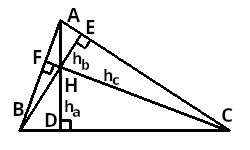
  • Definition: The height of a triangle is a straight line segment drawn from a vertex, perpendicular (at a 90-degree angle) to the opposite side. Every triangle has three heights. All three heights always cross each other at one single point, which is called the orthocenter.
  • The three heights of the triangle

    The three heights of the triangle

  • In the triangle △ABC ha is the height starting from the vertex A, perpendicular to the side BC, ha ⊥ BC. hb is the height starting from the vertex B, perpendicular to side AC, hb ⊥ AC. hc starts from the vertex C, perpendicular to the side AB, hc ⊥ AB. They all intersect at point H, the orthocenter.

  • Knowing the area and sides of the triangle, we can calculate the heights ha, hb and hc from vertices A, B and C to the sides a, b and c respectively.
  • Starting from the classic formula of area:
  • Area = 1/2 × a × ha =>
  • ha = 2 × Area / a ≈ 70.036172395399 ≈ 70.04
  • Area = 1/2 × b × hb =>
  • hb = 2 × Area / b ≈ 65.546674164925 ≈ 65.55
  • Area = 1/2 × c × hc =>
  • hc = 2 × Area / c ≈ 63.908007310802 ≈ 63.91

6. Calculate the lengths of the three medians of the triangle

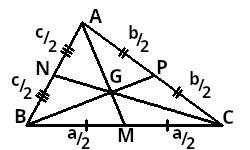
  • Definition: A median of a triangle is a line segment connecting a vertex of the triangle to the midpoint of the opposite side. Every triangle has three medians that meet at a single center point, called centroid.
  • The three medians of the triangle

    The three medians of the triangle

  • In the triangle △ABC ma is the median connecting the vertex A to the middle of side BC, mb is the median connecting the vertex B to the middle of side AC and mc is the median connecting the vertex C to the middle of the side AB. They all intersect at point G, the centroid.
  • The centroid G divides the lengths of the three medians as follows:
  • AG/AM = BG/BP = CG/CN = 2/3
  • GM/AM = GP/BP = GN/CN = 1/3
  • GM/AG = GP/BG = GN/CG = 1/2
  • Apollonius' Theorem

  • == Proof of the Apollonius' Theorem at the end of the section. ==
  • In a triangle △ABC, for which we know the lengths of the sides "a", "b" and "c", having the opposite vertices A, B and C, respectively, there is a relationship between the lengths of the sides and the lengths of the medians ma, mb and mc, where ma is drawn from vertex A to side "a", mb is drawn from vertex B to side "b", and mc is drawn from vertex C to side "c":
  • b2 + c2 = 2 × (ma2 + (a/2)2) =>
  • ma2 = (b2 + c2)/2 - (a/2)2= 4,909.75 =>
  • Median ma ≈ 70.069608247799 ≈ 70.07

  • a2 + c2 = 2 × (mb2 + (b/2)2) =>
  • mb2 = (a2 + c2)/2 - (b/2)2= 4,343.5 =>
  • Median mb ≈ 65.905234996926 ≈ 65.91

  • a2 + b2 = 2 × (mc2 + (c/2)2) =>
  • mc2 = (a2 + b2)/2 - (c/2)2= 4,106.5 =>
  • Median mc ≈ 64.081978745978 ≈ 64.08

  • Proof of the Apollonius' Theorem

  • We prove Apollonius' Theorem using the Law of Cosines, which we proved above, when we calculated the angles' measures.
  • The three medians of the triangle

    The three medians of the triangle

  • Let median AM, of lenght ma, divide the side BC, of length "a", into two equal parts, of length BM = CM = a/2. Also AB = c, AC = b, BC = a.
  • Let the measure of the angle ∡AMB = θ. Since two angles on a straight line add up to 180° then the adjacent angle ∡AMC = 180° - θ.
  • => cos(180° - θ) = - cos(θ)
  • Apply the Law of Cosines to the triangle △ABM, making sure to also include the angle ∡AMB = θ in the formula:
  • c2 = ma2 + (a/2)2 - 2 × ma × a/2 × cos(θ) =>
  • [1] c2 = ma2 + (a/2)2 - ma × a × cos(θ)
  • Apply the Law of Cosines to the triangle △ACM, making sure to also include the angle ∡AMC = 180° - θ in the formula:
  • b2 = ma2 + (a/2)2 - 2 × ma × a/2 × cos(180° - θ)
  • cos(180° - θ) = - cos(θ)
  • The above relation becomes:
  • [2] b2 = ma2 + (a/2)2 + ma × a × cos(θ)
  • Add the two equations [1] and [2] together. The terms ma × a × cos(θ) and - ma × a × cos(θ) cancel each other:
  • b2 + c2 = 2 × (ma2 + (a/2)2)

7. Calculate the radius of the inscribed circle

  • Intro

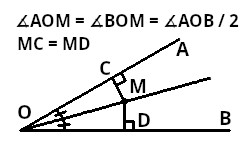
  • The bisector of an angle is a half-right inside the angle, with the origin at its apex, which forms two smaller congruent angles with the sides of the angle. Any point belonging to the bisector is equidistant from both sides of the angle.
  • Bisector of an angle

    Bisector of an angle

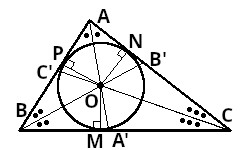
  • In any triangle the bisectors of the angles cross at the exact same point, which is the center of the circle tangent to the sides of the triangle, called the circle inscribed in the triangle. This is the largest circle that fits inside the triangle.
  • Bisectors and the circle inscribed in the triangle

    Bisectors and the circle inscribed in the triangle

  • In the triangle △ABC, AA' is the bisector of the angle ∠BAC => ∠BAA' = ∠CAA' = ∠BAC / 2
  • BB' is the bisector of the angle ∠ABC => ∠ABB' = ∠CBB' = ∠ABC / 2
  • CC' is the bisector of the angle ∠ACB => ∠ACC' = ∠BCC' = ∠ACB / 2

  • Bisectors AA', BB' and CC' intersect at point O, which is the center of the circle inscribed in the triangle. Why is this happening?

  • O is a point on the bisector AA' so it is equidistant from the line segments AB and AC => [1] the distance from the point O to the segment AB is OP, where OP ⊥ AB (⊥ is the symbol for perpendicular segments), [2] the distance from the point O to the segment AC is ON, where ON ⊥ AC and [3] OP ≅ ON.
  • O is a point on the bisector BB' so it is equidistant from the line segments AB and BC => [1] the distance from the point O to the segment AB is OP, where OP ⊥ AB, [2] the distance from the point O to the segment BC is OM, where OM ⊥ BC and [3] OP ≅ OM.
  • From the relations above, it follows that OM = ON = OP = r, where r is the radius of the circle inscribed in the triangle

Calculate the radius of the inscribed circle

  • To calculate the radius of the circle inscribed in the triangle, divide the area of ​​the triangle by its semiperimeter:
  • r = Area / s
  • Where:
  • r = radius of the circle inscribed in the triangle
  • s is the semiperimeter of the triangle, already calculated above

  • Why this formula? How to prove it?
  • The area of ​​the triangle △ABC = area △OAB + area △OBC + area △OAC = 1/2 × OP × AB + 1/2 × OM × BC + 1/2 × ON × AC = 1/2 × r × AB + 1/2 × r × BC + 1/2 × r × AC = 1/2 × r × (AB + BC + AC) = 1/2 × r × Perimeter = Perimeter/2 × r = Semiperimeter × r =>
    r = Area / Semiperimeter = Area / s

  • r = 2,556.320292432073 / 115.5 ≈ 22.13264322452 ≈ 22.13

8. Calculate the radius of the circumscribed circle

  • Intro

  • The perpendicular bisector of a segment is the line perpendicular to the segment that passes through its middle. Any point belonging to the perpendicular bisector is equidistant from the ends of the segment.
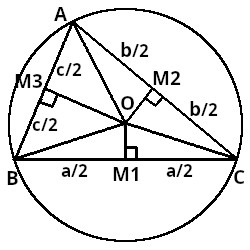
  • The perpendicular bisectors and circumcircle of the triangle

    The perpendicular bisectors and circumcircle of the triangle

  • In any triangle the perpendicular bisectors of the sides are concurrent in a point which is the center of the circle passing through the vertices of the triangle, called the circumscribed circle of the triangle.
  • In the triangle △ABC, OM1 is the perpendicular bisector of segment BC => BM1 = CM1 = BC / 2 = a / 2, where a is the length of segment BC.
  • OM2 is the perpendicular bisector of segment AC => AM2 = CM2 = AC / 2 = b / 2, where b is the length of segment AC.
  • OM3 is the perpendicular bisector of segment AB => AM3 = BM3 = AB / 2 = c / 2, where c is the length of segment AB.

  • The perpendicular bisectors OM1, OM2 and OM3 intersect at point O, which is the center of the circumscribed circle of the triangle. Why is this happening?

  • O is a point on the perpendicular bisector OM1 => BM1 = CM1 = a/2, OM1 ⊥ BC (⊥ is the symbol for segments or perpendicular lines), and OM1 common segment => right triangles △OBM1 ≅ △OCM1 => OB ≅ OC.
  • O is a point on the perpendicular bisector OM2 => AM2 = CM2 = b/2, OM2 ⊥ AC, and OM2 common segment => right triangles △OAM2 ≅ △OCM2 => OA ≅ OC.
  • From the relations above, it follows that OA = OB = OC = R, where R is the radius of the circle circumscribing the triangle.

Calculate the radius of the circumscribed circle

  • To calculate R, the radius of the circle circumscribing the triangle, apply the formula:
  • R = a × b × c / (4 × Area)
  • Where:
  • a, b and c are the lengths of the three sides of the triangle

  • Why this formula? How to prove it?
  • The Law of Sines establishes the relationship between the lengths of the sides a, b and c of a triangle, for example △ABC, and the sines of the opposite angles, ∠A, ∠B and ∠C:
  • [1] a/sin(∠A) = b/sin(∠B) = c/sin(∠C) = 2 × R
  • R is the radius of the circumscribed circle of the triangle △ABC
  • We also use the Trigonometric Formula of the Area which we proved above, when we have been calculating the area:
  • [2] Area = 1/2 × b × c × sin(∠A)

  • From relationship [1] we can deduce that:
  • [3] sin(∠A) = a/(2 × R)
  • Substitute for sin(∠A) in the relationship [2]:
  • Area = 1/2 × b × c × a/(2 × R) = a × b × c/(4 × R) =>
  • R = a × b × c/(4 × Area)

  • R = 73 × 78 × 80/(4 × 2,556.320292432073) ≈ 44.548408248035 ≈ 44.55

Final Answer. Solved Triangle Data. Summary:

Perimeter
231 units
Semiperimeter
115.5 units
Angle's measure ∡A
0.96024739125738 ≈ 0.96025 radians
55.018122807495 ≈ 55.018 degrees
55 degrees, 1 minutes and 5.24 seconds
Angle's measure ∡B
1.0663705735026 ≈ 1.06637 radians
61.098533258644 ≈ 61.099 degrees
61 degrees, 5 minutes and 54.72 seconds
Angle's measure ∡C
1.1149746888299 ≈ 1.11497 radians
63.883343933865 ≈ 63.883 degrees
63 degrees, 53 minutes and 0.04 seconds
Area
2,556.320292432073 ≈ 2,556.32 square units
Heights' lengths
ha = 70.036172395399 ≈ 70.04 units
hb = 65.546674164925 ≈ 65.55 units
hc = 63.908007310802 ≈ 63.91 units
Medians' lengths
ma = 70.069608247799 ≈ 70.07 units
mb = 65.905234996926 ≈ 65.91 units
mc = 64.081978745978 ≈ 64.08 units
Radius, Inscribed circle
22.13264322452 ≈ 22.13 units
Radius, circumscribed circle
44.548408248035 ≈ 44.55 units
  • Triangle △ABC with side lengths:  a = 73, b = 78, c = 80

    Triangle △ABC with side lengths: BC (a) = 73, AC (b) = 78, AB (c) = 80

Symbols used: + addition, - subtraction, × multiplication, / division, = equal, ≈ approximately, => logical implication, ∠ angle, ∡ measured angle, m(∡A) angle's measure, △ triangle, ⌒ arc of a circle, ⊥ perpendicular, ≅ congruence, π the constant ratio of a circle's circumference to its diameter, ° unit of the measured value of an angle and it is called degree(s), ∈ it belongs to, x2 x raised to the second power or x squared = x × x, sin(∠A) sine of angle A, cos(∠A) cosine of angle A, arccos(ratio) arccosine of given ratio.

Solving the LLL triangle, similar operations:

» Solve the triangle if the lengths of its three sides are 108, 84 and 32. Triangle Calculator: Angles, Area, (Semi)Perimeter, Heights, Medians, Circles Radii

» Triangles solved by visitors given the three sides' lengths, monthly performed operations

» Month 08, 2026 [August]: Triangles solved given the three sides' lengths, operations performed during the month of: August


How to solve a triangle knowing the lengths of its three sides?

What is a triangle?

  • triangle △ABC
    Triangle △ABC
    Given three non-collinear points A, B, C, the set formed by these three points, together with the set of all the points of the segments AB, BC and CA, is called the triangle determined by the points A, B, C. See the figure with the triangle △ABC representation.
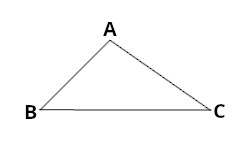
  • A triangle is a set of points in the plane forming a polygon that has three vertices, A, B, C, three sides, AB, BC, CA, and three angles, ∠ABC, ∠BCA, ∠CAB (or if there is no confusion, ∠A, ∠B, ∠C).
  • A vertex, in our case, A, is the point where two sides meet - AB and AC, the three vertices A, B, C are joined by three line segments, AB, BC, CA, called sides, which form three angles, ∠ABC, ∠BCA, ∠CAB, the sum of which is 180° (we demonstrate this down below).
  • The sides of the triangle are defined by the length of the three segments AB, BC and CA.
  • A triangle is usually designated by its vertices, in alphabetical order: △ABC. But the exact same triangle can also be written as: △ACB, △BAC, △BCA, △CAB, △CBA - that is, using all the combinations formed by the three letters.
  • triangle △ABC and a, b, c sides
    Triangle △ABC and a, b, c sides
    In the triangle △ABC the angle ∠A opposes the side BC, and reciprocally, the side BC opposes the angle ∠A. For the lengths of the sides of a triangle △ABC, the following notations are usually used: a = BC, b = CA, c = AB.
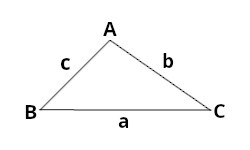
  • When all three sides are equal in length the triangle is called an equilateral triangle, while a triangle in which only two sides are equal in length is called an isosceles triangle. When the sides of a triangle have different lengths, it is called a scalene triangle.

Perimeter and semi-perimeter of a triangle

  • Perimeter: the sum of the lengths of the sides of a triangle △ABC is called the perimeter of the triangle and is denoted by:
    PABC = AB + BC + CA = c + a + b.
  • Semiperimeter: the half sum of the lengths of the sides of a triangle △ABC is called the semiperimeter of the triangle and is denoted by:
    pABC = (AB + BC + CA)/2 = (c + a + b)/2

Position of a point relative to a triangle

  • A point is called an interior point of a triangle if it lies inside each angle of the triangle.
  • A point that is neither inside the triangle nor on the sides of the triangle is called an outside point of the triangle.

Types of triangles in terms of angles

  • right triangle △ABC
    Right triangle △ABC
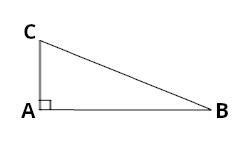
    A triangle that has a 90° angle, also called a right angle, is called a right triangle. If the right angle is A, then the sides that form the right angle, AB and CA, are called legs. The side opposite the right angle, BC, is called the hypotenuse. A triangle cannot have more than one right angle - since the sum of the three angles of a triangle must be 180° and if there were two right angles they would already measure 90° + 90° = 180°, with nothing left for the third angle.
  • acute scalene triangle △ABC
    Acute scalene triangle △ABC
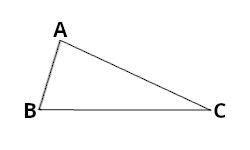
    A triangle that has all acute angles is called an acute triangle or acute scalene: ∠A < 90°, ∠B < 90°, ∠C < 90°.
  • obtuse scalene triangle △ABC
    Obtuse scalene triangle △ABC
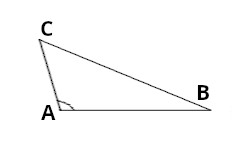
    A triangle that has an obtuse angle, i.e. greater than 90°, is called an obtuse triangle or obtuse scalene triangle: in our case, ∠A > 90°.
  • Equilateral triangle △ABC
    Equilateral triangle △ABC
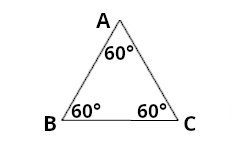
    A triangle that has all equal angles, also called congruent, ∡A = ∡B = ∡C = 180°/3 = 60°, is called an equilateral triangle. In an equilateral triangle all the sides are also congruent: AB ≅ BC ≅ CA.
  • Isosceles triangle △ABC
    Isosceles triangle △ABC
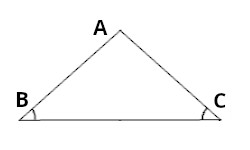
    A triangle that has only two congruent angles, for example ∠B ≅ ∠C, is called an isosceles triangle. In an isosceles triangle the sides opposite the congruent angles are also congruent. The third side of the isosceles triangle is called the base of the isosceles triangle.
Rules specific to triangles

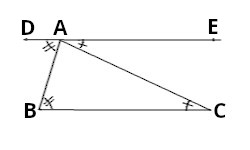
  • 1. The sum of measures of the angles in a triangle is always equal to 180°. See the figure below and related proof.
  • proof: sum of measures of the angles in any triangle is 180°
    Sum of angles' measures in a triangle
    Let △ABC be a triangle. We construct the parallel d through A to BC and the points D and E located on the line d, as in the figure. Points D, A and E, being located on the same line, are collinear. So DE ∥ BC ⇒ (1) ∠ABC ≅ ∠DAB - being alternate interior angles for DE ∥ BC and secant AB and (2) ∠ACB ≅ ∠CAE - being alternate interior angles for DE ∥ BC and secant AC. From (1) and (2) we obtain the relationship for the sum of the angles in the triangle △ABC: ∠ABC + ∠BAC + ∠ACB = ∠DAB + ∠BAC + ∠CAE = ∠DAE = 180°.
  • impossible triangle: sides
    Imposible triangle: sides
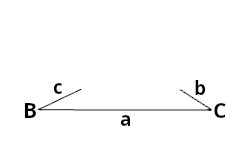
    2. In a triangle, the sum of the lengths of any two sides must be greater than the length of the third side, otherwise the triangle could not be constructed. In the next figure you can see that the length of side a is greater than the sum of the lengths of b and c: a > b + c. In this case the triangle △ABC cannot be constructed at all.
  • impossible triangle: angles
    Imposible triangle: angles
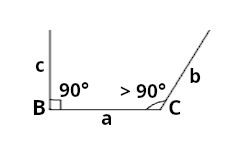
    3. A triangle can have only one angle that is greater than or equal to 90°. If a triangle had two angles of at least 90°, there would be nothing left for the third angle, according to rule no. 1. In our case, since ∡B = 90° and ∠C > 90°, the sides b and c cannot meet to form the vertex A of the triangle △ABC.
  • external angles
    External angles

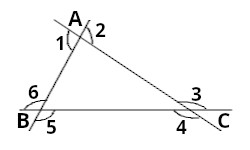
    4. The angle adjacent and supplementary to an angle of the triangle is called an exterior angle of the triangle. Any triangle has three pairs of exterior angles, six exterior angles in total. Each angle of the triangle has two pairs of exterior angles, congruent to each other, being opposite at the apex: angle ∠A has two exterior angles ∠1 and ∠2 - where ∠1 ≡ ∠2, angle ∠C has two exterior angles ∠3 and ∠4 - where ∠3 ≡ ∠4, and angle ∠B has two exterior angles ∠5 and ∠6, where ∠5 ≡ ∠6.

    The measure of an exterior angle of a triangle is equal to the sum of the measures of the angles not adjacent to it, since ∠A + ∠B + ∠C = 180° and ∠A + ∠1 = 180°, it follows that: ∡1 = 180° - ∠A and ∡1 = ∠B + ∠C; likewise, ∡2 = 180° - ∠A and ∡2 = ∠B + ∠C; ∡3 = 180° - ∠C and ∡3 = ∠A + ∠B; ∡4 = 180° - ∠C and ∡4 = ∠A + ∠B; ∡5 = 180° - ∠B and ∡5 = ∠A + ∠C; and finally ∡6 = 180° - ∠B and ∡6 = ∠A + ∠C.

    The sum of the measures of all exterior angles of a triangle is equal to: ∠1 + ∠2 + ∠3 + ∠4 + ∠5 + ∠6 = 2 × ∠1 + 2 × ∠3 + 2 × ∠5 = 2 × (∠1 + ∠3 + ∠5) = 2 × (180° - ∠A + 180° - ∠B + 180° - ∠C) = 2 × (3 × 180° - (∠A + ∠B + ∠C)) = 2 × (3 × 180° - 180°) = 2 × (2 × 180°) = 2 × 360° = 720°.

  • the larger side is opposed by the larger angle
    Larger side opposed by larger angle
    5. Whatever is a triangle with two non-congruent sides, the larger side is opposed by the larger angle. If a > b and a > c, then ∠A > ∠B and ∠A > ∠C.
How do you solve the triangle if you know the lengths of its three sides?

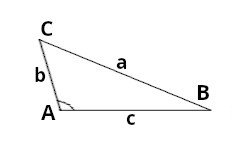
  • Knowing the lengths a, b, and c of the three sides of a triangle △ABC, where a is the side opposite angle ∠A, b is the side opposite angle ∠B, and c is the side opposite angle ∠C, each angle can be calculated using the formulas below.

The rearranged form of the Law of Cosines (or Cosine Rule)

  • This formula is used to calculate the measure of an angle in any triangle when you know the lengths of all three sides:
  • ∡A = arccos((b2 + c2 - a2) / (2 × b × c))
  • ∡B = arccos((a2 + c2 - b2) / (2 × a × c))
  • ∡C = arccos((a2 + b2 - c2) / (2 × a × b))
  • Example: Knowing the sides of a triangle, a = 7, b = 5 and c = 9, calculate the angles ∡A, ∡B and ∡C of the triangle:
  • ∡A =
    arccos((52 + 92 - 72) / (2 × 5 × 9)) =
    arccos((25 + (9 + 7) × (9 - 7))) / 90) =
    arccos((25 + 16 × 2)) / 90) =
    arccos((25 + 32)) / 90) =
    arccos(57/90) =
    arccos(0.6333) =
    0.88498643446628 radians =
    50.705987621249 degrees
  • ∡B =
    arccos((72 + 92 - 52) / (2 × 7 × 9)) =
    arccos((49 + (9 + 5) × (9 - 5))) / 126) =
    arccos((49 + 14 × 4)) / 126) =
    arccos((49 + 56)) / 126) =
    arccos(105/126) =
    arccos(0.8333) =
    0.58574584298534 radians =
    33.560764670393 degrees
  • ∡C =
    arccos((72 + 52 - 92) / (2 × 7 × 5)) =
    arccos((49 + (5 + 9) × (5 - 9))) / 70) =
    arccos((49 + 14 × -4)) / 70) =
    arccos((49 + -56)) / 70) =
    arccos(-7/70) =
    arccos(-0.1) =
    1.6709637479565 radians =
    95.739170477267 degrees
  • Check that the sum of the angles ∡A + ∡B + ∡C = 180°:
  • ∡A = 50.705987621249°
    ∡B = 33.560764670393°
    ∡C = 95.739170477267°
    ∡A + ∡B + ∡C =
    50.705987621249 + 33.560764670393 + 95.739170477267 =
    180.00592276891° ≈ 180°